
Rating Curve tool
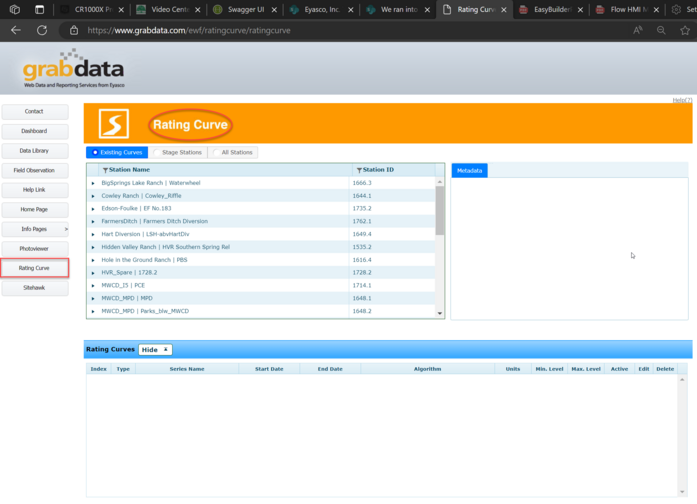
The browser-based Rating Curve tool is designed to convert a stage reading to a flow reading by applying an algorithm to the stage data. This works for three kinds of hydraulic structures: Stream, Weir and Flume. Each structure has its own single or multiple algorithms. For example, a Polynomial or Power equation can be used for streams. For weirs there are formulas for Rectangular Contracted, Rectangular Suppressed, V-Notch and Trapezoidal Contracted. There is also an application for Parshall Flumes. The details of each hydraulic structure algorithm are shown in the table below and discussed in more detail in the “CREATING CURVES” section.
|
Hydraulic Structures
|
Types
|
Calculation Equations
|
Notes
|
|
Stream
|
Polynomial
|
Ax^5+Bx^4+Cx^3+Dx^2+Ex+F
|
A, B, C, D, E, and F fields correspond to the 5th, 4th, 3rd, 2nd, 1st, and 0 polynomials
|
|
Power
|
Ax^B
|
A field represents the coefficient while the B field represents the exponent.
| |
|
Weir
|
Rectangular Contracted
|
Q = K (L-0.2H) H^1.5
|
Q = flow rate
H = head on the weir
L = crest length of weir
K = constant dependent upon units
|
|
Rectangular Suppressed
|
Q = K L H^1.5
|
Q = flow rate
H = head on the weir
L = crest length of weir
K = constant dependent upon units
| |
|
V-Notch
|
Q = K H^2.5
|
Q = flow rate
H = head on the weir
K = a constant, dependent on the angle of notch and units of measurement
| |
|
Trapezoidal
|
Q = K L H^1.5
|
Q = flow rate
H = head on the weir
L = crest length of weir
K = constant dependent upon units
| |
|
Flume
|
Parshall
|
Q = KH^n
|
Q = flow rate
H = head measured at point H
K = constant, dependent upon throat width and units
n = constant power, dependent upon throat width
|
There are also two 'special' algorithms available in the rating curve tool that are not strictly related to calculating flow. These are 'Vibrating Wire' and 'Math'. Vibrating wire is used for to convert In addition to strictly