
Weirs
There are four types of weirs included in the Grabdata Rating Curve Tool:
5. Rectangular Contracted
6. Rectangular Suppressed
7. V-Notch
8. Trapezoidal
Each type of weir has its own formula. The following sections show equations and discharge tables for weirs with head in feet for each of the above weir types.
Rectangular Contracted
|
Rectangular Contracted
|
 |
The formula for a Rectangular Contracted weir is: Q =K(L-0.2H)H1.5
Where: Q = flow rate
H = head on the weir
L = crest length of weir
K = constant dependent upon units
The discharge equations for rectangular weir with end contractions are as follows:
CFS: Q = 3.330 ( L - 0.2H ) H1.5
GPM: Q = 1495 ( L - 0.2H ) H1.5
MGD: Q = 2.152 ( L - 0.2H ) H1.5
Where: L = crest length of weir in feet and H is the head above the weir measured in steady-state flow upstream of the weir.
Rectangular Suppressed
|
Rectangular Suppressed
|
 |
The formula for a Rectangular Suppressed weir is: Q =KLH1.5
Where: Q = flow rate
H = head on the weir
L = crest length of weir
K = constant dependent upon units
The discharge equations for rectangular weir without end contractions are as follows:
CFS: Q = 3.330 L H1.5
GPM: Q = 1495 L H1.5
MGD: Q = 2.152 L H1.5
Where: L = crest length of weir in feet
V-Notch
|
V-Notch
|
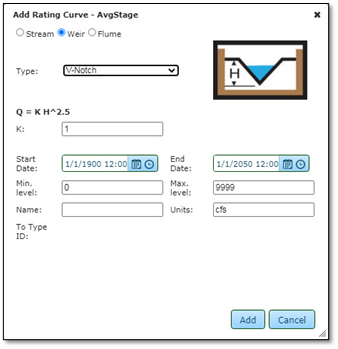 |
The formula for a V-Notch weir is: Q =KH2.5
Where: Q = flow rate
H = head on the weir
K = a constant, dependent on the angle of notch and units of measurement
Discharge Equations for V-Notch Weirs with Head in Feet for different notch angles are in the table below:
|
V-notch angle
|
CFS
|
GPM
|
MGD
|
|
22½°
|
Q = 0.4970 H2.5
|
Q = 223.1 H2.5
|
Q = 0.3212 H2.5
|
|
30°
|
Q = 0.6760 H2.5
|
Q = 303.4 H2.5
|
Q = 0.4369 H2.5
|
|
45°
|
Q = 1.035 H2.5
|
Q = 464.5 H2.5
|
Q = 0.6689 H2.5
|
|
60°
|
Q = 1.443 H2.5
|
Q = 647.6 H2.5
|
Q = 0.9326 H2.5
|
|
90°
|
Q = 2.500 H2.5
|
Q = 1122 H2.5
|
Q = 1.616 H2.5
|
|
120°
|
Q = 4.330 H2.5
|
Q = 1943 H2.5
|
Q = 2.798 H2.5
|
Trapezoidal (Cipolletti)
|
Trapezoidal
|
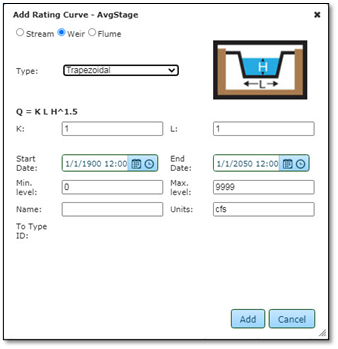 |
The formula for a Trapeziodal, or “Cipoletti” weir is: Q =KLH1.5
Where: Q = flow rate
H = head on the weir
L = crest length of weir
K = constant dependent upon units
The typical discharge equations for a Cipolletti Weir are as follows:
CFS: Q = 3.367L H1.5
GPM: Q = 1511L H1.5
MGD: Q = 2.176L H1.5
Where: L = crest length of the weir in feet